
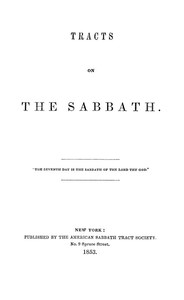
Tracts on the Sabbath by American Sabbath Tract Society
Don't go into this book expecting a novel. 'Tracts on the Sabbath' is a collection of persuasive essays, sermons, and arguments published in the 1800s by the American Sabbath Tract Society. Think of it as a campaign pamphlet, but for an idea. The society was a group of religious and community leaders deeply worried that the new rhythms of factory work, railroads, and commerce were destroying the traditional Christian Sabbath (Sunday). Their goal was simple: to defend Sunday as a mandatory day of rest, worship, and family time against what they saw as the corrosive forces of business and secular leisure.
The Story
There's no single narrative. Instead, you get a chorus of voices making the same case from different angles. One tract might argue from the Bible, citing the Fourth Commandment. Another paints a dramatic picture of social collapse—families falling apart, workers driven to exhaustion, and communities losing their moral glue—if Sunday becomes just another business day. Another takes a practical, almost public health angle, insisting that regular rest is physically and mentally necessary. They argue against Sunday mail delivery, Sunday travel, and even Sunday newspapers. The "plot" is their relentless effort to shape laws and public opinion, creating a unified front against the seven-day workweek.
Why You Should Read It
This book grabbed me because it's less about religion and more about cultural anxiety. Reading these tracts, you feel the panic of a society in overdrive. The authors are terrified of technology (the railroad!), economic pressure, and social change. Sound familiar? It's a raw look at how people try to hold onto tradition in a world that's speeding up. You don't have to agree with their conclusions to be fascinated by their fervor. It also shows how our modern concept of the "weekend" was forged in fire. That lazy Sunday morning? It was fought for by people like this.
Final Verdict
This is a niche read, but a rewarding one. It's perfect for history buffs, sociology nerds, or anyone curious about why our calendar looks the way it does. If you enjoy seeing the roots of today's debates about work, rest, and technology, you'll find this old text surprisingly relevant. It's not a page-turner in the usual sense, but as a piece of historical persuasion, it's utterly compelling. Just be ready—it might make you look at your next Sunday afternoon a little differently.
Joshua Gonzalez
10 months agoJust what I was looking for.
Ethan Clark
1 year agoI have to admit, the plot twists are genuinely surprising. One of the best books I've read this year.
Robert Lopez
5 months agoThe fonts used are very comfortable for long reading sessions.
Elijah Martin
1 month agoA must-have for anyone studying this subject.








Donald Taylor
2 years agoGood quality content.