
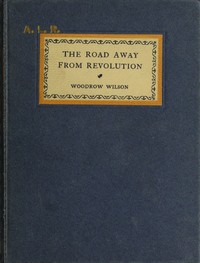
The Road Away from Revolution by Woodrow Wilson
Published in 1918, 'The Road Away from Revolution' is President Woodrow Wilson's direct response to the Bolshevik Revolution in Russia. The world was at war, and a new, frightening kind of upheaval had just begun. Wilson wasn't writing a history book; he was trying to diagnose a disease he saw spreading. The essay is his attempt to understand why masses of people turn to violent revolution and, more importantly, how to prevent it.
The Story
There's no traditional plot here, but the central argument has a clear narrative drive. Wilson lays out what he sees as the root cause of revolution: not just poverty, but a profound sense of injustice and the feeling that the system is rigged against the common person. He calls it the 'poison of disorder.' He then maps out his proposed 'road away' from this chaos. For Wilson, the solution isn't simply crushing revolt with force. It's about building a fairer world through cooperation between nations (the seed of his League of Nations idea), economic justice, and, above all, a shared moral commitment to the common good. He believed the alternative to revolution wasn't the status quo, but positive, progressive reform.
Why You Should Read It
Reading this today is a trip. You have to mentally place yourself in 1918, with the trenches of WWI still fresh and a radical new ideology seizing power. But then, the core issues jump off the page. Wilson's warnings about inequality breeding resentment, about the need for legitimacy in government, and about the dangers of a society split into haves and have-nots feel ripped from modern headlines. It's not a perfect or universally agreeable blueprint—his views are very much of his time and position—but the central question is timeless. It forces you to think: What are the essential ingredients for a stable society? His answer, focused on justice and shared purpose, is compelling even when you disagree with the details.
Final Verdict
This is a book for the curious reader, not the casual one. It's perfect for history buffs who want to get inside the head of a wartime president during a global crisis. It's also great for anyone interested in political philosophy or current events, as it provides a century-old lens to look at today's social and political tensions. It's short, so you can read it in one sitting, but it's dense with ideas that will stick with you. Don't read it for a balanced historical analysis; read it to engage with a primary source, a president's urgent attempt to make sense of a world coming apart. You'll come away with a lot to think about, and maybe even argue with.
Joshua Wright
1 year agoThis book was worth my time since the emotional weight of the story is balanced perfectly. Exactly what I needed.
Kenneth Ramirez
7 months agoEnjoyed every page.
Logan Thomas
4 months agoFive stars!
Linda Martinez
1 year agoWow.
George Nguyen
1 year agoThis book was worth my time since the author's voice is distinct and makes complex topics easy to digest. Exactly what I needed.