
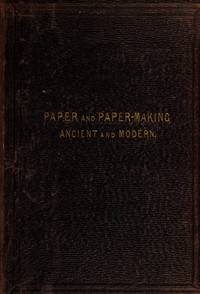
Paper & paper making, ancient and modern by Richard Herring
Let's be clear from the start: this isn't a novel. Paper & Paper Making, Ancient and Modern is a detailed technical manual and historical account written by a man who lived and breathed the craft. Richard Herring published this in 1856, and he writes with the authority of a master craftsman who has pulp under his fingernails.
The Story
The 'plot' follows the epic journey of paper itself. Herring starts at the very beginning in ancient China, showing how paper was a revolutionary leap over clay tablets and papyrus. He then tracks its slow march across the world to the Middle East and into Europe. The heart of the book, though, is the detailed, step-by-step breakdown of how paper was actually made in his time. He describes the vats, the molds, the pressing, and the drying lofts with loving precision. He doesn't just tell you paper is made from rags; he explains how the rags were sorted, fermented, and beaten into a fine pulp. The final chapters look to the future, discussing the urgent 19th-century search for new raw materials like esparto grass and wood pulp to keep up with the exploding demand for print.
Why You Should Read It
You should read it because it makes you see the physical world differently. After reading Herring's descriptions, you'll never look at a sheet of paper the same way. You'll feel the texture and imagine the thousands of tiny fibers locked together. You'll appreciate it as a marvel of engineering, not just a blank surface. Herring's passion is contagious. He isn't a dry historian; he's a booster for his industry, excited about its past and its potential. Reading his careful explanations of a process we now take completely for granted is a humbling and fascinating experience. It connects you directly to the material history of knowledge.
Final Verdict
This book is a niche treasure. It's perfect for history buffs, makers, artists, or anyone with a deep curiosity about the everyday objects that surround us. If you love shows like How It's Made or get lost in Wikipedia holes about industrial history, you'll adore this. It's not a light read—Herring's 19th-century prose takes some getting used to—but the payoff is a profound new appreciation for one of humanity's most foundational inventions. Just be prepared to start feeling and sniffing every piece of paper you pick up afterward.
Anthony Jackson
1 year agoFrom the very first page, it manages to explain difficult concepts in plain English. A true masterpiece.



Brian Flores
2 months agoAfter hearing about this author multiple times, the arguments are well-supported by credible references. I learned so much from this.