
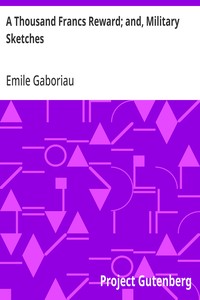
A Thousand Francs Reward; and, Military Sketches by Emile Gaboriau
Let's talk about a founding father of detective fiction. Emile Gaboriau is a name that often gets overshadowed by later giants like Conan Doyle, but his creation, Monsieur Lecoq, is a direct ancestor of Sherlock Holmes. This book gives you a great taste of his work.
The Story
The title story, 'A Thousand Francs Reward,' is a proper mystery. A man has vanished. His family, worried and confused, posts a substantial reward for news of his whereabouts. The local police are stumped. Enter Monsieur Lecoq. He's not flashy, but he's brilliant. He pieces together the man's last known movements, interviews witnesses everyone else ignored, and follows a trail of seemingly insignificant details. It's a masterclass in early forensic deduction. The 'Military Sketches' that follow are different—they're vivid, short portraits of soldiers and life in the ranks. They're less about solving a crime and more about capturing the humor, hardship, and sudden moments of courage in army life.
Why You Should Read It
There's a real charm in seeing the detective genre in its infancy. Gaboriau's writing is clear and direct, focusing on the puzzle and the people. Monsieur Lecoq feels fresh because he relies on logic and observation, not supernatural luck. You can see the gears turning. Reading this, you get a real sense of 'Oh, so THIS is where that came from.' It’s also a snapshot of 19th-century France—the social tensions, the class divisions, and the early days of professional policing. The military sketches add nice variety, showing Gaboriau's range beyond just mysteries.
Final Verdict
This book is perfect for mystery lovers who want to explore the classics, and for history buffs interested in 19th-century society. If you enjoy Sherlock Holmes, Father Brown, or Hercule Poirot, you owe it to yourself to meet one of their literary grandparents. The pace is different from modern thrillers—it takes its time setting the scene—but the payoff in clever deduction is thoroughly satisfying. Think of it as a fascinating and entertaining history lesson, wrapped up in a very good yarn.
Dorothy Torres
1 year agoWithout a doubt, it creates a vivid world that you simply do not want to leave. Thanks for sharing this review.
Joseph Thompson
1 year agoText is crisp, making it easy to focus.
James Walker
1 year agoI started reading out of curiosity and it provides a comprehensive overview perfect for everyone. I learned so much from this.
Kimberly Scott
9 months agoText is crisp, making it easy to focus.

Liam Davis
1 year agoCompatible with my e-reader, thanks.